The Meaning of the 1st Baby Born Each Yeary
The nascency rate in the Eu decreased at a slower footstep between 2000 and 2019 than before
In 2019, 4.167 million children were born in the EU, corresponding to a crude birth rate (the number of live births per i 000 persons) of 9.3. For comparison, the EU crude birth rate was 10.v in 2000, 12.eight in 1985 and xvi.iv in 1970.
During the period 1961–2019, the highest annual full for the number of alive births in the EU was recorded in 1964, at vi.797 million. From this relative high upward to the beginning of the 21st century, the number of live births in the EU declined at a relatively steady step, reaching a low of 4.365 one thousand thousand in 2002 (see Figure 1). This was followed by a small-scale rebound in the number of alive births, with a high of 4.675 million children born in the EU in 2008, in turn followed by further annual reductions up to 2019 (four.167 million live births).

Figure 1: Number of alive births, EU, 1961–2019 (meg)
Source: Eurostat (demo_gind)
1.53 live births per woman in the European union in 2019
In recent decades, Europeans have generally been having fewer children, and this blueprint partly explains the slowdown in the European union's population growth (see Population and population change statistics). The nigh widely used indicator of fertility is the full fertility rate: this is the mean number of children that would be built-in live to a woman during her lifetime if she were to pass through her childbearing years conforming to the age-specific fertility rates of a given year. A total fertility rate of around 2.1 live births per woman is considered to be the replacement level in developed countries: in other words, the average number of live births per woman required to keep the population size constant in the absence of migration. A total fertility rate below 1.three live births per adult female is oft referred to as 'lowest-low fertility'. The full fertility rate is comparable across countries since information technology takes into account changes in the size and construction of the population.
In 2019, the total fertility rate in the EU was 1.53 live births per woman (as compared to 1.54 in 2018 - Figure 2). The EU'south total fertility rate rose from a low of 1.43 in 2001 and 2002 to a relative high of 1.57 in 2010, subsequently followed past a slight decrease to 1.51 in 2013 before a minor rebound upwards to 2017.

Figure 2: Total fertility rate, EU, 2001–2019
Source: Eurostat (demo_find)
Figure 3 shows that the mean age of women at childbirth connected to rise between 2001 and 2019, from an average of 29.0 to thirty.9 years. One fractional explanation for the increase in the total fertility charge per unit is that information technology may have been related to a catching-up process: following the trend to give birth later in life (witnessed by the increase in the hateful historic period of women at childbirth), the full fertility charge per unit might have declined get-go, earlier a subsequent recovery. An increase in the mean age of women at birth of first child can also exist observed, from a value of 28.eight in the Eu in 2013 to a value of 29.four in 2019.

Effigy 3: Mean age of women at childbirth and at birth of first child, EU, 2001–2019
Source: Eurostat (demo_find)
Indeed, women in the EU appear to exist having fewer children while they are immature, and more than children afterward. Effigy 4 shows the growing relevance of fertility at ages college than 30 in the Eu. While the fertility rates of women aged less than thirty in the Eu take declined since 2001, those of women anile 30 and over have risen. In 2001, the fertility rate of women aged 25-29 years old was highest among all the age groups. In 2019, the fertility rate of women aged 30-34 became the highest. The fertility rate at ages higher than 35 is likewise rising.
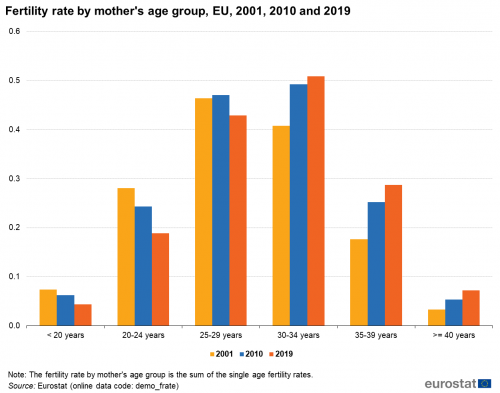
Figure four: Fertility rate by mother's age group, EU, 2001, 2010 and 2019
Source: Eurostat (demo_frate)
Amongst the EU Member States, France reported the highest total fertility rate in 2019, with 1.86 alive births per woman, followed by Romania, with 1.77 live births per woman and Ireland, Sweden and Czechia all with 1.71 live births per adult female. Past contrast, the everyman total fertility rates in 2019 were recorded in Malta (one.xiv live births per woman), Spain (1.23 alive births per woman), Italian republic (one.27 live births per woman), Cyprus (ane.33 alive births per woman), Greece and Luxembourg (both 1.34). In most of the EU Fellow member States, the full fertility charge per unit declined considerably between 1980 and 2000–2003: by 2000, values had fallen below 1.thirty in Bulgaria, Czechia, Greece, Spain, Italian republic, Latvia, Slovenia and Slovakia. After reaching a depression betoken between 2000 and 2003, the total fertility rate increased in many Member States and by 2019, all of them except Malta, Spain and Italy reported total fertility rates that were above 1.30 (Tabular array 1).
In the past 45 years, full fertility rates in the EU Member States take, in full general, been converging: in 1970, the disparity between the highest rates (recorded in Ireland) and the everyman rates (recorded in Finland) was around two.0 alive births per woman. By 1990 this divergence — between a high in Cyprus and a low in Italy — had decreased to i.1 live births per woman. By 2010, the divergence had fallen again to 0.viii live births per woman with a high in Ireland and a low in Hungary. By 2019 the difference narrowed to 0.7 when the highest total fertility charge per unit was recorded again in France and the everyman rate was recorded in Malta.

Table i: Full fertility rate, 1960–2019 (alive births per adult female)
Source: Eurostat (demo_find)
Total fertility rate and age of women at birth of first child
Figure 5 shows a plot of the total fertility charge per unit against the mean historic period of women at the birth of their first child in 2019. Some of the countries with the highest total fertility rates too had a relatively high mean age of women at the birth of their first child. Four different groups of European union Member States can be broadly identified based on their position with respect to the Eu averages (as identified by the quadrants defined past the blue lines). The first grouping (height right quadrant) is composed of Denmark, Germany, Republic of ireland, holland, Sweden and Norway where both the full fertility rate and the mean historic period of women at the birth of their beginning child were higher up the EU average. A second group (bottom left quadrant) is made upwardly of Croatia, Malta and Poland: both their full fertility rates and mean ages of women at the birth of their first child were beneath the EU averages, as was also the case in North Macedonia and Serbia. A third group (bottom correct quadrant) composed Greece, Spain, Italy, Republic of cyprus, Luxembourg, Austria and Portugal, also every bit Switzerland recorded a higher than average mean age of women at the birth of their first child but a lower total fertility rate than the EU average. The terminal grouping (height left quadrant) was composed of Belgium, Bulgaria, Czechia, Estonia, French republic, Republic of latvia, Republic of lithuania, Hungary, Romania, Slovenia and Slovakia, as well as Iceland and Turkey; in each of these, the total fertility rate was higher than the EU average only the mean age of women at the nascence of their first child was below the Eu boilerplate. In Finland the mean historic period of women at the birth of their commencement child was the same as the Eu average, while the total fertility rate was beneath the Eu boilerplate.

Figure 5: Fertility indicators, 2019
Source: Eurostat (demo_find)
Equally can be seen in Map 1, 29.4 years was the mean historic period of women at nascence of first child in the EU in 2019. The lowest mean age at nascence of first child can exist found in Republic of bulgaria (26.3 years) and Romania (26.9 years); the highest values can exist observed in Italy (31.3 years) and in Kingdom of spain and Grand duchy of luxembourg (both 31.1 years).

Map 1: Hateful age of women at birth of first child, 2019
Source: Eurostat (demo_find)
Nigh one fifth of children born in the European union in 2019 were third born or subsequent children
Close to one-half (45.viii %) of the children born in the EU in 2019 were first built-in children, with this share exceeding half in Romania, Malta, Luxembourg, Portugal, and Republic of bulgaria (come across Figure 6). By dissimilarity, the lowest shares of kickoff built-in children were recorded in Republic of ireland and Estonia (both with 38.8 %) and Latvia (39.0 %).
In the EU, more than i tertiary (35.7 %) of all live births in 2019 were of 2nd built-in children, effectually one 8th (12.half dozen %) were of third built-in children, and the remaining 5.9 % were of fourth born or subsequent children. Across the Eu Fellow member States, the highest share of the total number of live births ranked fourth or subsequent was recorded in Republic of finland (10.3 %), followed past Republic of ireland (9.0 %) and Belgium (8.1 %). Turkey likewise recorded a high share of live births ranked fourth or subsequent (12.7 %).

Figure half dozen: Share of live births by birth order, 2019
(%)
Source: Eurostat (demo_find)
More than 65 % of the children born in Grand duchy of luxembourg in 2019 were from foreign-built-in mothers (meet Figure 7). In Cyprus, Austria and Belgium around i third of children were built-in in 2019 to foreign-born mothers and two thirds were born to native-born mothers. On the other hand, 98 % of live births in 2019 in Bulgaria, Slovakia and Poland were built-in to native-born mothers. Compared to 2013, most of the European union countries in 2019 showed an increase in live births from strange-born mothers. Malta recorded the highest increase in alive births from foreign-born mothers (19 p.p. from 11 % in 2013 to 30 % in 2019) followed by Greece (seven p.p. from xiv % to 21 %), Spain (half-dozen p.p. from 22 % to 28 %) and Sweden (5 p.p. from 26 % in 2013 to 31 % in 2019) .

Figure 7: Share of live births from foreign-born and native-born mothers, 2019
(%)
Source: Eurostat (demo_facbc)
Data sources
Eurostat compiles data for a big range of demographic data, including statistics on the number of live births past sex (of new-borns), by the mother'southward historic period, citizenship, country of nativity, level of educational attainment and marital status. Fertility statistics are also collected in relation to the number of births and by nascence gild (in other words, the rank of the kid — beginning, second, tertiary kid and so on). A serial of fertility indicators is produced from the information collected, including the total fertility rate and fertility rates co-ordinate to the mother'south age, the hateful age of women at childbirth, the crude nascency charge per unit or the relative proportion of births exterior of marriage.
Context
The European union's social policy does non include a specific strand for family issues. Policymaking in this area remains the sectional responsibility of European union Member States, reflecting different family structures, historical developments, social attitudes and traditions from one Member Land to another. Nevertheless, policymakers may well evaluate fertility statistics every bit a groundwork for family unit policymaking. Furthermore, a number of mutual demographic themes are apparent across the whole of the EU, such every bit a reduction in the average number of children beingness born per woman and the increasing mean age of mothers at childbirth.
The Eu has been going through a menstruation of demographic and societal change. The outbreak of the COVID-xix pandemic will get out a lasting touch on the style we live and work together. The outbreak came at a time when Europe had already been going through a period of profound demographic and societal change. More than information of the piece of work of the European Commission 2019-2024 to tackle the touch on of demographic change in Europe can be found in the European Committee defended pages.
davidsonweent1999.blogspot.com
Source: https://ec.europa.eu/eurostat/statistics-explained/index.php?title=Fertility_statistics

Post a Comment for "The Meaning of the 1st Baby Born Each Yeary"