The Second Reading in a Catholic Mass
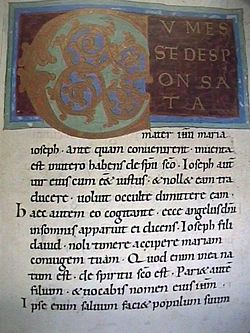
A lectionary (Latin: lectionarium) is a book or listing that contains a collection of scripture readings appointed for Christian or Judaic worship on a given day or occasion. There are sub-types such as a "gospel lectionary" or evangeliary, and an epistolary with the readings from the New Attestation Epistles.
History [edit]
The Talmud claims that the practice of reading appointed Scriptures on given days or occasions dates back to the time of Moses and began with the annual religious festivals of Passover, Pentecost, and the Feast of Tabernacles (Talmud, Megilah 32a). The Mishnah portion of the Talmud, probably finished in the early third century Advertising/CE (Anno Domini or Common Era) contains a list of Torah readings for various occasions (Talmud, Megilah 32a) and assumes that these special readings interrupt a regular schedule of Torah readings (Talmud, Megilah 29a, 30b). In addition to these Torah readings, the later Gemara portion of the Talmud also contains assigned annual readings from the prophets (Talmud, Megilah 31a).
By the Medieval era the Jewish community had a standardized schedule of scripture readings from both the Torah and the prophets to be read in the synagogue. A sequential selection was read from the Torah, followed by the "haftarah" – a selection from the prophetic books or historical narratives (e.thou. "Judges," "Kings," etc.) closely linked to the choice from the Torah. Jesus may have read a providentially "random" reading when he read from Isaiah 61:i-2, as recorded in Luke 4:xvi–21, when he inaugurated his public ministry. The early on Christians adopted the Jewish custom of reading extracts from the Erstwhile Testament on the Sabbath. They soon added extracts from the writings of the Apostles and Evangelists.[one]
Both Hebrew and Christian lectionaries adult over the centuries. Typically, a lectionary will go through the scriptures in a logical pattern, and as well include selections which were chosen by the religious customs for their appropriateness to particular occasions. The ane-twelvemonth Jewish lectionary reads the entirety of the Torah within the infinite of a twelvemonth and may have begun in the Babylonian Jewish community; the three-year Jewish lectionary seems to trace its origin to the Jewish community in and around the Holy Land.[two] The being of both one-year and three-twelvemonth cycles occurs in both Christianity and Judaism.
Inside Christianity, the use of pre-assigned, scheduled readings from the scriptures can be traced back to the early on church, and seems to take developed out of the practices of the second temple period. The earliest documentary record of a special book of readings is a reference by Gennadius of Massilia to a piece of work produced by Musaeus of Marseilles at the request of Bishop Venerius of Marseilles, who died in 452, though at that place are tertiary-century references to liturgical readers as a special part in the clergy.[3] [4] Not all of the Christian Church used the same lectionary, and throughout history, many varying lectionaries have been used in different parts of the Christian earth. Until the Second Vatican Council, most Western Christians (Catholics, Sometime Catholics, Anglicans, Lutherans, and those Methodists who employed the lectionary of Wesley) used a lectionary that repeated on a one-year footing. This annual lectionary provided readings for Sundays and, in those Churches that celebrated the festivals of saints, feast-twenty-four hour period readings. The Eastern Orthodox Church and many of the Oriental Churches continue to employ an almanac lectionary. Inside Lutheranism in that location remains an active minority of pastors and congregations who use the old one-year lectionary, oft referred to as the Historic Lectionary. The Reformed churches divided the Heidelberg Canon into 52 weekly sections, and many churches preach or teach from a corresponding source scripture weekly.
Lectionaries from earlier the invention of the printing press contribute to understanding the textual history of the Bible. Run into also List of New Testament lectionaries.
Western lectionaries [edit]
At Mass in the Latin Rite before the Second Vatican Quango [edit]
Before the liturgical reforms of Vatican Two, the Latin rite used a i-year lectionary consisting of a limited selection of sacred readings from the Scriptures. The reason to these limited selections is to maintain consistency, as is a true characteristic in the Roman Rite. At that place is one reading to exist proclaimed before the Gospel, either taken from the Old Testament (referred to as Lesson) or from the letters of Saint Paul, Saint John, or Saint Peter (referred to as Epistle).
The Lesson (or Epistle) is contained in a book called the Epistolarium, a liturgical book containing the epistles that were to exist said or sung by a subdeacon at a solemn High Mass. The Gospels are independent in a book chosen Evangeliarium, or more recently chosen as "Book of the Gospels", that were to exist said or sung by a deacon at a solemn High Mass.
However, the Ambrosian Rite and the Mozarabic Rite has two Readings to be proclaimed, called Prophetia and Epistola.
Cosmic Mass Lectionary and the Revised Mutual Lectionary [edit]

After the Second Vatican Council of 1962–1965, the Holy See, even before producing an actual lectionary (in Latin), promulgated the Ordo Lectionum Missae (Lodge of the Readings for Mass), giving indications of the revised structure and the references to the passages chosen for inclusion in the new official lectionary of the Roman Rite of Mass. It introduced an arrangement past which the readings on Sundays and on some master feasts recur in a iii-year cycle, with four passages from Scripture (including ane from the Psalms) being used in each celebration, while on weekdays only three passages (again including ane from the Psalms) are used, with the first reading and the psalm recurring in a two-twelvemonth wheel, while the Gospel reading recurs after a single year. This revised Mass Lectionary, covering much more of the Bible than the readings in the Tridentine Roman Missal, which recurred after a single yr, has been translated into the many languages in which the Roman Rite Mass is now celebrated, incorporating existing or especially prepared translations of the Bible and with readings for national celebrations added either as an appendix or, in some cases, incorporated into the master part of the lectionary.
The Roman Catholic Mass Lectionary is the ground for many Protestant lectionaries, most notably the Revised Mutual Lectionary (RCL) and its derivatives, as organized past the Consultation on Common Texts (CCT) organization located in Nashville, Tennessee. Like the Mass lectionary, they generally organize the readings for worship services on Sundays in a iii-year cycle, with 4 elements on each Sun, and iii elements during daily Mass:
- Kickoff reading (Prima lectio) from the One-time Testament or, in Eastertide from sure books of the New Testament;
- Responsorial psalm (Psalmus responsorium) (ideally, to be sung, every bit contained in the Simple Gradual) or Gradual (every bit contained in the Roman Gradual);
- Second reading (Secunda lectio) from i of the New Attestation Letters (only on Sundays and Solemnities); and a
- Gospel reading (Evangelium).
3-year cycle [edit]

A German Roman Catholic lectionary for year C on an ambo after Mass
The lectionaries (both Cosmic and RCL versions) are organized into iii-year cycles of readings. The years are designated A, B, or C. Each yearly cycle begins on the first Sunday of Advent (the Lord's day betwixt November 27 and Dec iii inclusive). Twelvemonth B follows year A, year C follows yr B, then back over again to A.
- Yr A: Gospel of Matthew (Advent 2019 through 2020)
- Yr B: Gospel of Mark (Advent 2020 through 2021)
- Year C: Gospel of Luke (Advent 2021 through 2022 - current twelvemonth)
The Gospel of John is read throughout Easter, and is used for other liturgical seasons including Advent, Christmas, and Lent where advisable.
Daily lectionaries [edit]
The Roman Catholic lectionary includes a two-year cycle for the weekday mass readings (called Wheel I and Cycle Two). Odd-numbered years are Cycle I; even-numbered ones are Cycle 2. The weekday lectionary includes a reading from the Old Testament, Acts, Revelation, or the Epistles; a responsorial Psalm; and a reading from one of the Gospels. These readings are generally shorter than those appointed for use on Sundays. The pericopes for the offset reading along with the psalms are arranged in a two-year bike. The Gospels are arranged then that portions of all four are read every twelvemonth. This weekday lectionary has also been adapted past some denominations with congregations that gloat daily Eucharistic services. It has been published in the Episcopal Church's Lesser Feasts and Fasts and in the Anglican Church building of Canada's Book of Alternative Services (among others).
This eucharistic lectionary should not be confused with the various Daily Office lectionaries in use in diverse denominations. The Consultation on Common Texts has produced a 3-year Daily Lectionary which is thematically tied into the Revised Common Lectionary, but the RCL does not provide a daily Eucharistic lectionary as such. Various Anglican and Lutheran Churches have their own daily lectionaries. Many of the Anglican daily lectionaries are adapted from the 1 provided in the 1979 Book of Common Prayer.
Other lectionary information [edit]
In some churches, the lectionary is carried in the entrance procession by a lector. In the Catholic Church, the Book of the Gospels is carried in past a deacon (when there is no deacon, a lector might procedure in with the Book of the Gospels). When the Volume of the Gospels is used, the offset ii readings are read from the lectionary, while the Book of the Gospels is used for the final reading.
The lectionary is not to be dislocated with a missal, gradual or sacramentary. While the lectionary contains scripture readings, the missal or sacramentary contains the appropriate prayers for the service, and the gradual contains chants for use on any particular day. In particular, the gradual contains a responsory which may be used in place of the responsorial psalm.
Eastern lectionaries [edit]

In the Eastern Churches (Eastern Orthodox, Oriental Orthodox, Eastern Catholic, the Assyrian Church of the East, Aboriginal Church of the East, and those bodies not in communion with whatever of them simply still practicing eastern liturgical community) tend to retain the use of a one-twelvemonth lectionary in their liturgy. Different churches follow unlike liturgical calendars (to an extent). Most Eastern lectionaries provide for an epistle and a Gospel to exist read on each day. The oldest known complete Christian Lectionary is in the Caucasian Albanian language.

An example of Byzantine lectionary — Codex Harleianus (50 150), AD 995, text of John one:18.
Byzantine lectionary [edit]
Those churches (Eastern Orthodox and Byzantine Catholic) which follow the Rite of Constantinople, provide an epistle and Gospel reading for virtually days of the year, to be read at the Divine Liturgy; withal, during Bang-up Lent there is no commemoration of the liturgy on weekdays (Monday through Friday), and then no epistle and Gospel are appointed for those days. Every bit a historical note, the Greek lectionaries are a chief source for the Byzantine text-type used in the scholarly field of textual criticism.
Epistle and Gospel [edit]
The Gospel readings are institute in what Orthodoxy usually calls a Gospel Volume (Evangélion), although in strict English terms the Greek ones are in the course of an Evangeliary, and an Epistle Book (Apostól). There are differences in the precise organisation of these books between the various national churches. In the Byzantine practice, the readings are in the form of pericopes (selections from scripture containing merely the portion actually chanted during the service), and are arranged co-ordinate to the order in which they occur in the church year, beginning with the Dominicus of Pascha (Easter), and continuing throughout the unabridged yr, terminal with Holy Week. Then follows a section of readings for the commemorations of saints and readings for special occasions (baptism, funeral, etc.). In the Slavic practice, the biblical books are reproduced in their entirety and arranged in the canonical order in which they announced in the Bible.
The annual cycle of the Gospels is equanimous of four series:
- The Gospel of St. John
- read from Pascha until Pentecost Dominicus
- The Gospel of St. Matthew
- divided over seventeen weeks beginning with the Monday of the Holy Spirit (the day subsequently Pentecost). From the twelfth calendar week, it is read on Saturdays and Sundays while the Gospel of St. Marking is read on the remaining weekdays
- The Gospel of St. Luke
- divided over 19 weeks starting time on the Monday later on the Sunday after the Height of the Holy Cross. From the thirteenth week, it is only read on Saturdays and Sundays, while St. Mark's Gospel is read on the remaining weekdays
- The Gospel of St. Marker
- read during the Lenten menstruum on Saturdays and Sundays — with the exception of the Sunday of Orthodoxy.
The interruption of the reading of the Gospel of Matthew afterward the Acme of the Holy Cross is known as the "Lukan Jump" The leap occurs just in the Gospel readings, at that place is no corresponding jump in the epistles. From this point on the epistle and Gospel readings do non exactly represent, the epistles continuing to be adamant co-ordinate to the moveable Paschal cycle and the Gospels beingness influenced by the fixed cycle.
The Lukan Jump is related to the chronological proximity of the Elevation of the Cross to the Conception of the Forerunner (St. John the Baptist), celebrated on September 23. In tardily Antiquity, this feast marked the showtime of the ecclesiastical New year's day. Thus, beginning the reading of the Lukan Gospel toward the middle of September can exist understood. The reasoning is theological and is based on a vision of Salvation History: the Formulation of the Forerunner constitutes the first stride of the New Economic system, as mentioned in the stikhera of the matins of this feast. The Evangelist Luke is the only ane to mention this Conception (Luke 1:five–24).
In Russian federation, the use of the Lukan Jump vanished; however, in contempo decades, the Russian Church has begun the process of returning to the employ of the Lukan Jump.
Similarly to the Gospel Cycle, Epistle readings follow this plan although some exceptions vary:
- Book of Acts of Apostles
- read from Pascha until Pentecost Sunday
- Letter to the Romans, 1 Corinthians and 2 Corinthians
- From Pentecost to Elevation of the Holy Cantankerous
- Galatians, Ephesians, Philippians, Colossians, one Thessalonians, ii Thessalonians, ane Timothy, two Timothy, Hebrews
- From Elevation of the Holy Cross to the Circumcision of Christ, 1st of January
- James, Hebrews, 1 Peter and 2 Peter
- read from the Circumcision of Christ to the Make clean Monday, first weekday of Great Lent.
Onetime Testament readings [edit]
Other services have scriptural readings also. At that place is a Gospel lesson at Matins on Sundays and banquet days. These are constitute in the Evangelion. There are also readings from the Old Attestation, chosen "parables" (paroemia), which are read at vespers on banquet days. These parables are found in the Menaion, Triodion or Pentecostarion. During Great Lent, parables are read every twenty-four hour period at vespers and at the Sixth Hr. These parables are found in the Triodion.
Syriac and Malankara churches: Catholic, Orthodox [edit]
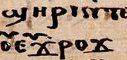
Small portion of a Coptic lectionary
In the Jacobite Syriac Churches, the lectionary begins with the liturgical calendar year on Qudosh `Idto (the Sanctification of the Church), which falls on the eighth Sun before Christmas. Both the Old and the New Testament books are read except the books of Revelation, Vocal of Solomon, and I and II Maccabees. Scripture readings are assigned for Sundays and feast days, for each day of Lent and Holy Week, for raising people to various offices of the Church, for the blessing of Holy Oil and various services such every bit baptisms and funerals.
Generally, three Old Attestation lections, a selection from the prophets, and iii readings from the New Attestation are prescribed for each Lord's day and Feast mean solar day. The New Testament readings include a reading from Acts, another from the Catholic Epistles or the Pauline Epistles, and a third reading from ane of the Gospels. During Christmas and Easter a fourth lesson is added for the evening service. The readings reach a climax with the approach of the week of the Crucifixion. Through Lent lessons are recited twice a solar day except Saturdays. During the Passion Week readings are assigned for each of the major canonical hours.
If there is a weekday Liturgy historic on a non-banquet day, the custom is to read the Pauline epistle merely, followed by the Gospel.
Encounter also [edit]
- Volume of Alternative Services
- Dominical letter
- Ekphonetic notation
- Gospel Volume
- Lection
- Lector
- List of New Testament lectionaries
- Liturgical year
- Manzil
- Mass (liturgy)
- Pericope
- Revised Mutual Lectionary
- The Text This Week
- Weekly Torah portion
- The Syro-Aramaic Reading of the Koran
References [edit]
- ^ "Lectionary". Encyclopædia Britannica Online . Retrieved 2007-07-06 .
- ^ Elbogen, Ismar. Jewish Liturgy: A Comprehensive History. Original publication 1913. Trans Raymond P. Scheindlin for Jewish Publication Society edition 1993.
- ^ "Lectionary". Britannica. Retrieved 12 February 2022.
- ^ Palazzo,Eric, A History of Liturgical Books from the Start to the Thirteenth Century, p. 91, 1998, Liturgical Press, ISBN 081466167X, 9780814661673, google books
Farther reading [edit]
- Evans, Helen C. (2004). Byzantium: faith and power (1261-1557) . New York: The Metropolitan Museum of Art. ISBN1588391132.
- Evans, Helen C.; Wixom, William D. (1997). The glory of Byzantium: art and culture of the Middle Byzantine era, A.D. 843-1261 . New York: The Metropolitan Museum of Art. ISBN9780810965072.
External links [edit]
 | Look up lectionary in Wiktionary, the gratuitous dictionary. |
- Thesaurus Antiquorum Lectionariorum Ecclesiae Synagogaeque A database on ancient and medieval Jewish and Christian lectionaries allowing to automatically compare 25000 readings of ca. 35 lectionaries of many aboriginal denominations (Jewish Ashkenazy, Sephardic, Yemenite, Byzantine, Italian, Talmuds, Mishnah, Tosefta, Rav Saadia Gaon, some Midrashim, triannual from the Geniza, Armenian rite of Jerusalem, Gallican, Mozarabic, Roman, Byzantine, Coptic, W- and East Syriac, Maronite). Automatic synopsis and automated calendar reconstruction tools.
- Greek Orthodox Online Chapel lectionary Lectionary of the Greek Orthodox Church according to the typicon of the Ecumenical Patriarchate
- Books and Resource Books and resource to learn more about the Eucharistic lectionary.
- The Revised Common Lectionary
- The Roman Cosmic Lectionary - based on the New American Bible, as approved by the United States Briefing of Catholic Bishops (as well used in the Philippines)
- General Introduction to the Lectionary (Roman Catholic)
- The Articulation Liturgical Group (United kingdom of great britain and northern ireland) – which developed The 4 Twelvemonth Lectionary (One Gospel per Twelvemonth)
- Narrative Lectionary with history, contexts, and links to readings
- The "Lukan Jump" Orthodox Research Institute
- Orthodox Christian Lectionary Explained (Russian Orthodox)
- Lectionary of the Syriac Orthodox Church
- Herbermann, Charles, ed. (1913). . Catholic Encyclopedia. New York: Robert Appleton Visitor.
- Roman Catholic Lectionary for Mass Resources for the study of the electric current Roman Catholic lectionary.
- "The 4 Gospels" a lectionary in Syriac from 1687
davidsonweent1999.blogspot.com
Source: https://en.wikipedia.org/wiki/Lectionary

Post a Comment for "The Second Reading in a Catholic Mass"